Here’s a quick and dirty way to check power MOSFETs, the type used as choppers in switching power supplies and output stages in other applications, like pulse-width-modulated (PWM) digital audio amplifiers and motor controllers, where the transistor operates as a switch, rather than as a variable resistance element. These are enhancement-mode FETs, and this test will work only with them; it won’t work with the depletion-mode FETs commonly used in stages that handle small signals.
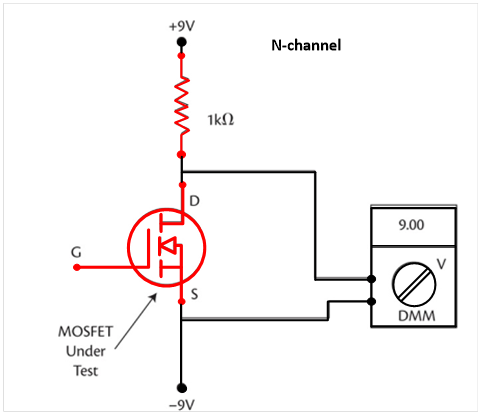
Take a 9-volt battery and a 1-kΩ resistor and connect them as shown in Figure . Set your DMM to read voltage, and connect it across the drain and source of the FET. Leave the gate terminal unconnected. Touch two of the fingers of one hand between the gate and drain terminals momentarily. The voltage shown on the meter should drop quite a bit and stay at the lower value after you release your fingers. This indicates that the gate of the FET is positively charged and is turning on the drain-to-source path, as it should. Now, touch your fingers between the gate and source terminals and let go. The voltage should rise back up to the battery’s voltage and stay there because you’ve discharged the gate. If you get these behaviors, the part is good.
Most of the power MOSFETs you’ll encounter are N-channel, and their pinout, left to right, is usually gate-drain-source (GDS). For a P-channel part, you can do the test the same way. Just reverse the battery polarity and expect to see a minus sign on your DMM’s display.